
sale2@tongyundiaosu.com
0086-15188960033
Leonardo’s Horse (Gran Cavallo) was originally commissioned from Leonardo da Vinci in 1482 by the Duke of Milan, Ludovico il Moro, but the project was never completed. Leonardo conducted detailed studies of horse anatomy and created extensive drawings and a clay model for what was intended to be the world’s largest equestrian statue. However, the bronze reserved for casting the sculpture was eventually repurposed to produce cannons. The full-scale clay model was later damaged by invading French troops in 1499 and ultimately deteriorated due to exposure to the elements.
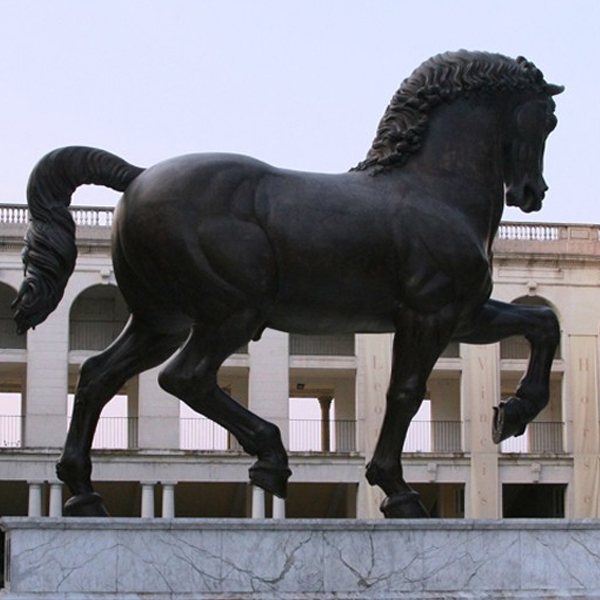
More than five centuries later, Japanese-American sculptor Nina Akamu brought Leonardo’s vision to life. One full-size bronze version of the horse now stands at the Hippodrome de San Siro in Milan, unveiled in 1999, while a second is located in Grand Rapids, Michigan. A number of smaller-scale reproductions of the work are also displayed in various locations around the world.
The "Chariot of Glory" stands atop the Triumphal Arch in Palace Square, St. Petersburg, serving as a powerful emblem of Russian triumph. Created by the renowned architect Carlo Rossi, this sculptural group was designed to commemorate Russia’s historic victory over Napoleon in 1812. The composition depicts a chariot drawn by six horses, guided by a winged figure representing Glory, symbolizing the nation’s resilience and ascendancy. As an integral part of the arch’s architectural ensemble, it not only celebrates military success but also embodies the artistic grandeur of 19th-century Russian Neoclassicism. Today, it remains one of St. Petersburg’s most iconic monuments, attracting visitors from around the world.
Contact: Mr.Li
Phone: 0086-15188960033
E-mail: sale2@tongyundiaosu.com
Whatsapp:008615188960033
Add: Changucheng Industrial Zone,Tang County,Baoding City,Hebei Province,China.
We chat